10 Best Beginner Baitcaster Combos
From leading brands and best sellers available on the web.By clicking on a link to a third party's website, log data is shared with that third party.
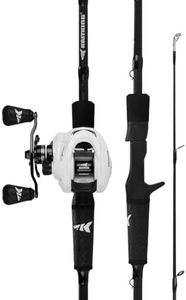
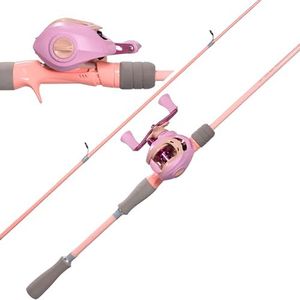
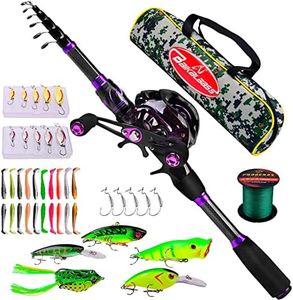
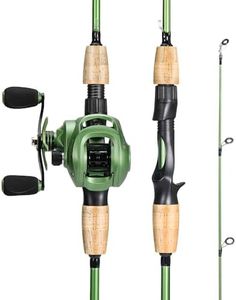
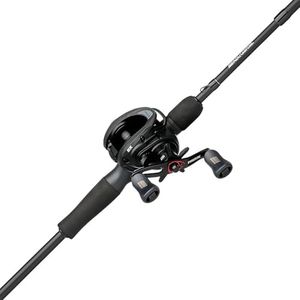
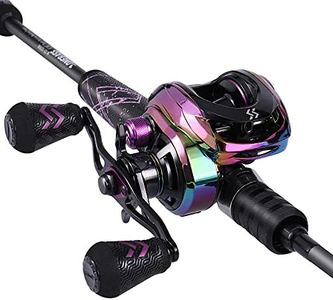
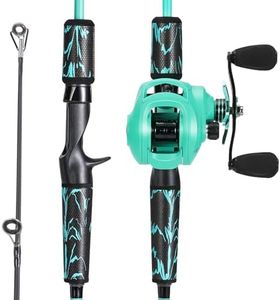
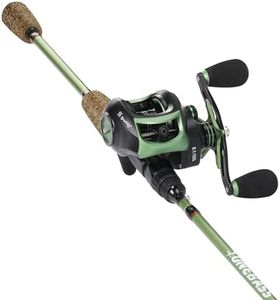
Buying Guide for the Best Beginner Baitcaster Combos
Choosing your first baitcaster combo can be an exciting step in fishing as it opens up new techniques and gives you better accuracy and control compared to spinning reels. However, baitcasters can seem intimidating for beginners due to the learning curve, especially around managing line control and avoiding tangles. The best approach is to understand the key specifications that make a baitcaster beginner-friendly and match your choice to your fishing style and local conditions. Think about where and how you’ll fish most often: ponds, lakes, rivers, or maybe learning in your backyard. Comfort and ease of use should top your list, letting you focus more on catching fish than on untangling your line.Gear RatioThe gear ratio of a baitcaster refers to how many times the spool rotates for each turn of the reel handle. This impacts how fast you can retrieve your line. Lower gear ratios, such as 5:1 or 6:1, retrieve slower and give you more power, which is handy for lures that need a slow presentation or working with larger fish. Higher gear ratios like 7:1 and above bring in the line quickly, great for techniques like topwater or when you want to cover more water. Beginners often do well with a moderate gear ratio, such as 6:1 to 7:1, which provides a good balance for various fishing styles and helps keep things simple as you learn.
Rod Length and PowerRod length affects casting distance and accuracy, while rod power tells you how much force is needed to bend the rod. Shorter rods, around 6’ to 7’, offer better accuracy and are easier for beginners to handle, especially from boats or tight spots. Longer rods (over 7’) can cast farther but may feel awkward at first. For power, look for 'medium' or 'medium-heavy', as these are versatile and help you fish a variety of lures and sizes of fish without being too stiff or too soft. As a beginner, opt for a rod that feels comfortable in your hands and matches the type of fish and lures you expect to use most.
Braking SystemThe braking system in a baitcaster helps control the speed of the spool during a cast, which is crucial for beginners to prevent backlash (bird’s nests). There are magnetic and centrifugal brakes, and some reels offer both. Magnetic brakes are easier to adjust on-the-fly, while centrifugal brakes are dialed in before casting. For beginners, look for combos that have easy-to-adjust braking systems; start with stronger brakes to minimize tangles, and loosen them as your thumb control improves over time.
Line CapacityLine capacity tells you how much fishing line the reel can hold, usually described in yards for a certain strength of line. As a beginner, you don’t need extra-long capacity—something moderate (like 100-150 yards of 10-12lb test line) is practical for most freshwater situations. Too much line or too heavy a line can make control harder when you are starting out, so choose a standard setup that matches the fish local to your area and the lures you want to try.
Combo MatchA well-matched combo ensures that the rod and reel work well together, which is important for ease of use and learning. When picking a combo, make sure the reel is not too bulky for the rod, and the rod has enough strength for the targeted species and lure weight. Manufacturers usually design pre-matched combos for general purpose fishing, which is a good starting point for beginners. Focus on combos that state their suitability for beginners or for certain fish types and check the recommended lure and line ratings—those should be wide enough to cover the fishing styles you want to learn.