10 Best Budget Car Amplifier
From leading brands and best sellers available on the web.By clicking on a link to a third party's website, log data is shared with that third party.
Related Products
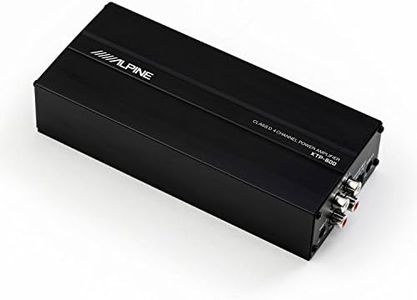
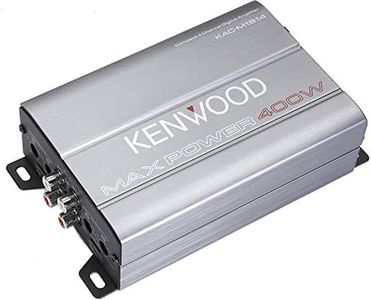
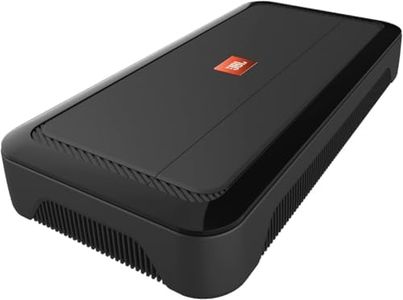
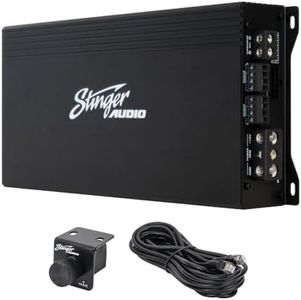
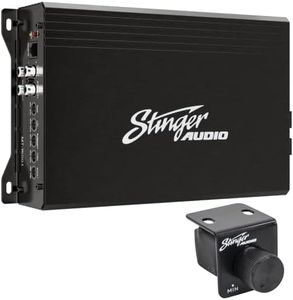
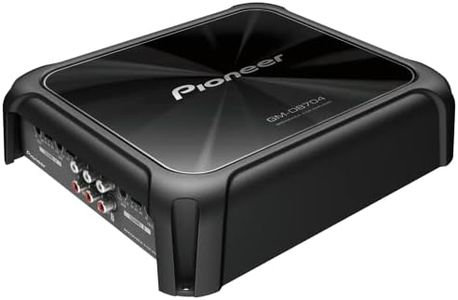
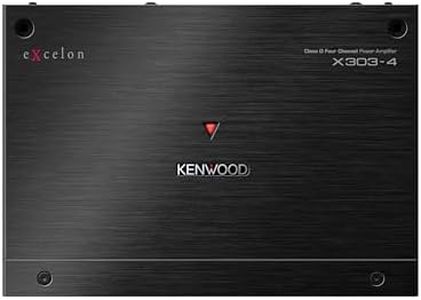
Recommended lists

Top rated
Car Amplifiers
Buying Guide for the Best Budget Car Amplifier
Choosing the right car amplifier can dramatically improve your in-car audio experience, making your music sound clearer, richer, and more powerful. To find the perfect fit, it’s important to consider your own listening habits, the audio system you already have or plan to install, and the size of your vehicle. Understanding the main specifications of car amplifiers will help you match an amp to your speakers or subwoofers and avoid problems like distortion or system overload.Power Output (Watts RMS)Power output, usually measured in watts RMS, tells you how much continuous power the amplifier can deliver to your speakers or subwoofer. This spec is crucial because it should match the power requirements of your speakers for optimal sound without distortion. Lower wattage (20-50W RMS per channel) works well for basic factory speakers or casual listening. Moderate wattage (50-100W RMS per channel) is good for most aftermarket speakers and gives a noticeable boost in volume and clarity. Higher power (100W+ RMS per channel) is great for powerful speakers, subwoofers, or louder listening. To choose the right power level, check your speaker's recommended RMS rating and pick an amp that matches or slightly exceeds it.
Number of ChannelsChannels refer to the number of speaker outputs an amplifier has. This matters because you need enough channels to connect all your speakers and subwoofers. Two-channel amps are ideal for powering a pair of speakers or a single subwoofer (if bridged). Four-channel amps can support front and rear speakers or two speakers plus a subwoofer. Five-channel or more are for complete systems with several speakers and a sub. Assess how many speakers or subs you want to power, and pick an amp with that many channels, or consider an amp that can be bridged if you plan to combine outputs for more power.
Amplifier Class (Class A, B, AB, D)Amplifier class describes the technology and efficiency of the amp. Class A/B amps traditionally provide good sound quality and are commonly used for powering door speakers. Class D amplifiers are more efficient, generate less heat, and are usually lighter and smaller—perfect for subwoofers or tighter installations. For everyday listening with standard speakers, a Class A/B is often fine. For subwoofers or high-power needs in compact spaces, a Class D is usually the better choice.
Signal-to-Noise Ratio (S/N Ratio)Signal-to-noise ratio (S/N ratio) tells you how clean the sound will be compared to potential background noise. Higher values mean you’ll hear more music and less unwanted hiss or static. Typical values range from 80dB (entry-level) to over 100dB (high-fidelity amps). For daily driving and most listening, an S/N ratio above 80dB is suitable, but if you're sensitive to noise or want very clean audio, aim for an amp rated at least 90dB.
Input Sensitivity/CompatibilityInput sensitivity determines how easily the amp can accept a signal from your head unit or stereo. Some amps are designed for factory stereos (high-level inputs), while others need aftermarket head units (low-level RCA inputs). Many modern amps offer both types. Ensure the amp you pick matches the outputs of your car’s stereo to avoid installation headaches and ensure proper volume and sound quality.
Size and Installation FlexibilityThe physical size of the amplifier matters because it needs to fit somewhere in your car—under a seat, in the trunk, or in a custom location. Compact amps are easier to install but might offer less power, while larger amps offer more power but limit placement options. Before buying, measure your intended space and compare it to the amp's dimensions, and consider how much air circulation the amp will need to avoid overheating.