9 Best Compost Accelerators
From leading brands and best sellers available on the web.By clicking on a link to a third party's website, log data is shared with that third party.
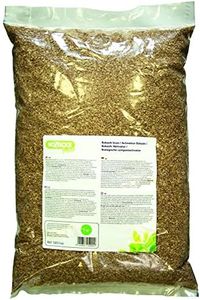
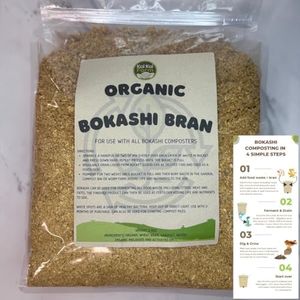
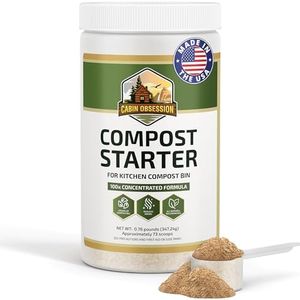
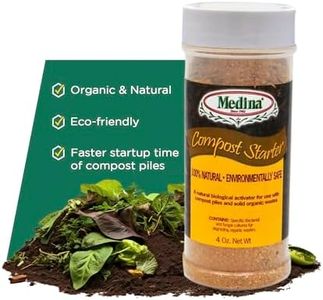
Buying Guide for the Best Compost Accelerators
Choosing the right compost accelerator can make the process of composting faster and more efficient, helping you turn food scraps, yard waste, and other organic materials into rich, usable compost in less time. When choosing a compost accelerator, it’s helpful to understand the basic science behind composting: microorganisms, like bacteria and fungi, break down organic matter, and compost accelerators are designed to boost their activity. With a little knowledge about what matters, you can select a product that matches your composting goals and habits.Type of AcceleratorCompost accelerators come in various forms, mainly as powders, liquids, or granular add-ins. The type relates to how the product is applied and how quickly it becomes active in your compost. Powders and granules are sprinkled on, while liquids are poured. Liquids often activate faster, while powders and granules may blend better for larger piles. Choose the form based on whether you’re composting in a small bin (liquid may be easier) or in a larger outdoor pile (powder or granule can cover more area evenly).
Microbial ContentThis spec tells you what kinds of beneficial microbes or enzymes are included in the accelerator. These tiny organisms drive the decomposition process. Some accelerators contain only bacteria, while others include a mix of bacteria and fungi for broader organic breakdown. For fast results or to handle tougher materials (like sticks or leaves), a mix of bacteria and fungi is helpful. If you’re mainly composting kitchen scraps, simpler bacterial blends can be enough. Consider what goes into your compost when choosing.
Nutrient AdditivesSome accelerators add nutrients like nitrogen, phosphorus, or trace minerals to feed microbes and speed up composting. High nitrogen formulas are good for piles heavy on dry leaves and cardboard, while lower-nitrogen versions work if your compost already has grass clippings or food scraps. Check your compost pile’s balance, and if you notice slow decomposition or a lot of woody material, an accelerator with nutrient additives could help.
Application RateApplication rate tells you how much accelerator you need to use per amount of compost material or per surface area. Lower application rates mean product lasts longer, while higher rates might be required for bigger or tougher piles. If you compost only occasionally or have a small bin, look for options with small, manageable doses. For frequent large-scale composting, a product with a higher application rate might speed things up, but be sure it matches your volume and frequency of composting.
Suitability for Compost TypeSome compost accelerators are designed for outdoor piles, others for tumblers or closed bins. This specification means the formula performs best under certain conditions—outdoor piles may need microbe blends that tolerate temperature swings, while bin or tumbler accelerators may focus on fast-acting bacteria for controlled environments. Match the accelerator to your method: If you compost in a tumbler or bin, choose a suitable formula; for outdoor piles or heaps, pick one that works in varying conditions.