10 Best Electric Ratchet Wrenches
From leading brands and best sellers available on the web.By clicking on a link to a third party's website, log data is shared with that third party.

Related Products

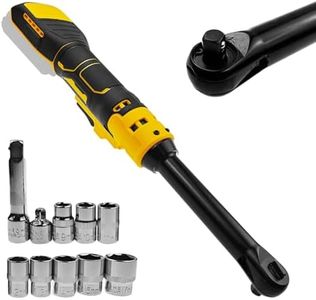

Buying Guide for the Best Electric Ratchet Wrenches
When choosing an electric ratchet wrench, it’s important to focus on how you’ll use it—home repairs, automotive work, or professional projects. Think about the tasks you’ll tackle most often, and remember that comfort in handling and performance are key. Understanding the main features and how they relate to your needs will help you make a confident, smart purchase.Power Source (Corded vs. Cordless)Electric ratchet wrenches come in two main power types: corded, which plug into a wall outlet, and cordless, which run on rechargeable batteries. Cordless wrenches offer greater portability and are excellent for working in tight or awkward spaces, but you need to recharge or change batteries. Corded options provide consistent power without concerns about battery life, but they limit your movement to where you have access to a power outlet. Home users and those working in multiple locations usually benefit from cordless versions, while stationary workbenches might do fine with a corded tool.
Drive SizeThe drive size refers to the diameter of the square fitting where you attach sockets, most commonly 1/4-inch, 3/8-inch, or 1/2-inch. Smaller drive sizes are ideal for light duty and tight spaces, typical for home tasks or electronics. Medium drive sizes (3/8-inch) are good all-rounders for most car and general repair work, providing a balance between power and access. Larger drive sizes (1/2-inch) handle tougher tasks, loosening bigger bolts in heavy machinery or vehicles. Select based on the typical bolt sizes and toughness of your common jobs.
Maximum TorqueTorque is the force the wrench can apply to turn a fastener, measured in foot-pounds (ft-lbs) or Newton-meters (Nm). Lower torque ratings (below 30 ft-lbs) suit delicate or light jobs, while mid-level torque (around 30–60 ft-lbs) is suitable for most household and automotive work. Higher torque (above 60 ft-lbs) lets you tackle bigger bolts or rusted fasteners, more common in professional or large vehicle work. For occasional home or light automotive use, you rarely need the highest torque ratings.
Speed (RPM)Speed is measured in revolutions per minute (RPM), indicating how quickly the wrench can turn a fastener. Lower speeds give you more control and are ideal for precise tasks, while higher speeds let you finish big jobs faster. For general home and car repair, mid-range speeds strike a good balance, but for work requiring lots of repetitive fastening, choosing a wrench with higher maximum RPM can save you time. Look for variable speed controls if you want to adjust speed for different tasks.
Size and ErgonomicsThe physical size and design of the wrench affect comfort and your ability to reach tight spaces. Smaller, lightweight models are easier to handle for long periods or when working in cramped areas, while larger models may have more power but be heavier and harder to maneuver. Think about where you’ll use the tool most often—if you regularly work inside engine bays or other restricted spots, a compact, ergonomic design will make your job much easier.
Battery Life and Charging TimeFor cordless models, battery life is a practical consideration—it determines how long you can work before needing a recharge. Longer battery life is better for extended jobs or work away from power sources. Charging time matters too: faster charging means less downtime. Some wrenches offer interchangeable batteries so you can swap in a fresh one and keep working. If you plan on using your wrench a lot, especially for professional use, these features are worth considering.