9 Best Emergency Distress Beacons
From leading brands and best sellers available on the web.By clicking on a link to a third party's website, log data is shared with that third party.
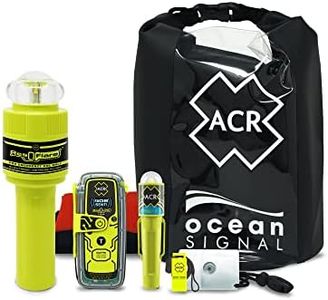
Buying Guide for the Best Emergency Distress Beacons
Choosing an emergency distress beacon is an important step for anyone who spends time in remote or risky environments, such as at sea, in the wilderness, or on adventurous journeys. These devices are designed to send a signal when you are in trouble, alerting rescuers to your exact location. Picking the right beacon depends on understanding how they work and which features suit your particular needs, whether you're boating, hiking, or taking long road trips off the grid.Beacon Type (PLB, EPIRB, ELT)There are several types of distress beacons: Personal Locator Beacons (PLBs), Emergency Position Indicating Radio Beacons (EPIRBs), and Emergency Locator Transmitters (ELTs). PLBs are designed for individuals on land or at sea, EPIRBs are primarily for maritime use, and ELTs are for aircraft. Understanding which type you need depends on where you will be using it; hikers and campers usually opt for PLBs, sailors need EPIRBs, and pilots use ELTs.
Battery LifeBattery life refers to how long the beacon can operate and send signals after being activated. This is crucial because a longer battery life increases your chances of being found if you have to wait a long time for rescue. Battery runtimes are divided into basic (24-30 hours), mid-range (40-48 hours), and extended (over 48 hours). If you go on short day trips, a basic battery may be enough, but for prolonged adventures, look for beacons with the longest battery life possible.
Signal Transmitting PowerThe power of the signal determines how easily your distress message can be detected by satellites and rescuers. Higher signal strength usually means your location can be pinpointed more quickly and accurately. Most beacons have standard transmitting power suitable for their intended use, but if you tend to travel in areas with dense cover (like forests or valleys), consider devices advertised for strong, far-reaching signals.
Satellite Network CompatibilityDistress beacons typically use the 406 MHz frequency, which is monitored globally by the COSPAS-SARSAT satellite network. This spec ensures your signal will reach rescuers nearly anywhere on Earth. Some devices may also offer additional satellite compatibility or even send GPS coordinates directly. If global reach is crucial for your activities, make sure the device is fully COSPAS-SARSAT compatible.
GPS FunctionalityModern beacons usually include built-in GPS, which allows them to send your exact coordinates when you activate the device. GPS-enabled beacons can get you help much faster because rescuers know precisely where you are. Some beacons only send a generic distress signal without GPS, so if precision location data is important for your safety, choose one with integrated GPS.
Activation MethodSome beacons are manually activated, meaning you need to press a button to send a distress signal, while others (like EPIRBs) can also be water-activated if submerged. Manual activation gives you full control, while automatic activation can be life-saving in situations where you cannot physically activate the beacon. Consider how likely it is that you might be unable to turn on the beacon yourself based on your planned activities.
Size and WeightThe size and weight of a beacon influence how easy it is to carry or mount. Compact, lightweight models are best for hikers and solo travelers who need to minimize their load, while larger beacons might offer more features but be better suited for vehicles, boats, or aircraft where size and weight are less critical.
Waterproof and Durability RatingsA good distress beacon should be waterproof and highly durable to withstand harsh conditions. They are usually rated by IP codes or depth and time standards (like IPX7 or submersible to 10 meters for an hour). If your activities involve risk of immersion or exposure to the elements, choose a model with high waterproof and ruggedness ratings to ensure it functions when you need it most.