6 Best Garage Ceiling Fans
From leading brands and best sellers available on the web.By clicking on a link to a third party's website, log data is shared with that third party.

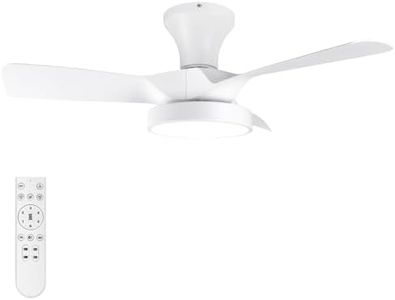


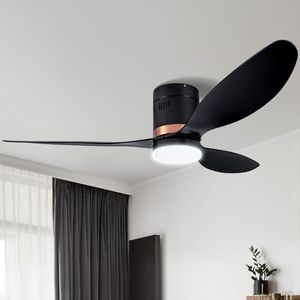
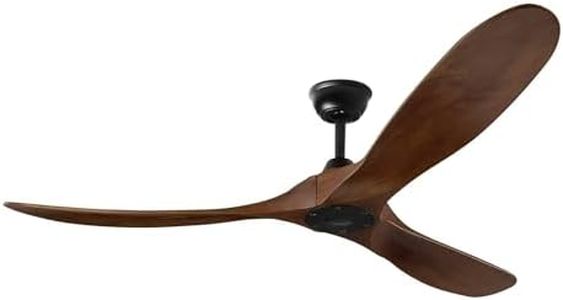
Buying Guide for the Best Garage Ceiling Fans
Choosing the right garage ceiling fan can greatly improve comfort, air circulation, and even help with temperature control in your workspace. A good fan will keep the air fresh, help manage humidity, and make your time in the garage far more pleasant, especially during hot weather or when working on projects. There are several features and technical specifications to consider that will guide you to the best fit for your needs.Fan Size (Blade Span)Fan size, also known as blade span, determines how much area the fan can effectively circulate air. Small fans (around 36-44 inches) are best for compact, one-car garages, while medium fans (44-56 inches) suit standard two-car garages. Large fans (over 56 inches) can handle bigger spaces or workshops. To pick the right size, measure your garage and choose a fan that matches the room size for balanced airflow without overwhelming or under-serving the space.
CFM (Cubic Feet per Minute)CFM stands for Cubic Feet per Minute and measures how much air the fan moves. Higher CFM means stronger airflow. For garages, you'll want a fan with medium to high CFM to handle the typically stuffy environment and possible fumes. Low CFM (under 3,000) works for small, less-used garages, medium CFM (3,000-6,000) fits active two-car garages or workshop spaces, and high CFM (over 6,000) is ideal for larger or heavily used garages. Pick a fan that matches the size of your garage and how much airflow you need, especially if you'll be working with tools or cars.
Motor Type & DurabilityThe type of motor determines how quietly and efficiently your fan operates. Most fans use either standard AC motors or more energy-efficient DC motors. DC motors tend to be quieter and consume less electricity. For a garage, you'll also want a motor with good durability, often rated as 'damp' or 'wet' for resistance to humidity and dust. Choose a durable, reliable motor if your garage experiences temperature swings, moisture, or dust, which can shorten the life of less robust motors.
Mounting Options & Ceiling HeightMounting options refer to how the fan is installed, considering your ceiling height and structure. Standard downrod mounts are common for regular-height ceilings, while flush or 'hugger' mounts are meant for lower ceilings. For tall garage ceilings, you might need an extended downrod so the fan hangs at an optimal height. When choosing, make sure the fan isn’t too low to interfere with vehicles or workspace, but also not too high to be ineffective. Match the mounting type to your ceiling height and room configuration for safety and best performance.
Reversible Airflow FunctionA reversible fan lets you change the direction the blades spin, which is useful for both summer and winter ventilation. In summer, the fan pushes air downward for cooling. In winter, reversing the airflow helps push warm air that rises back down, keeping the space warmer. If you use your garage year-round, choosing a fan with reversible airflow can make a big difference in comfort across seasons.
Lighting IntegrationSome garage ceiling fans come with built-in lights, which can add valuable illumination to your workspace. Integrated lighting can be especially handy if your garage lighting is limited. You can choose between fans with LED or other bulb types, and consider the brightness you need. If you already have plenty of lighting installed, you might not need this feature, but it's helpful for multitasking in darker garages.
Control OptionsFans can be controlled by pull chains, wall switches, or remotes. Remotes offer flexibility, especially in busy or large garages, while wall switches can be more permanent and neat. Pull chains are simple and reliable for smaller setups. To select the right one, think about your typical usage and whether you want easy access while moving around your garage.