10 Best Generators For Home Use
From leading brands and best sellers available on the web.By clicking on a link to a third party's website, log data is shared with that third party.



Related Products
Up to 10% off

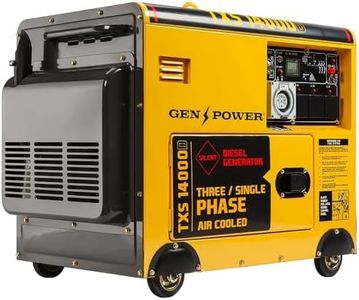
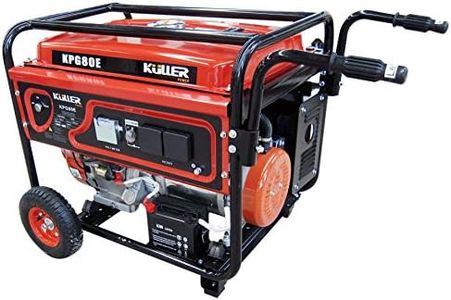
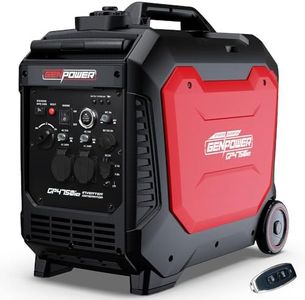
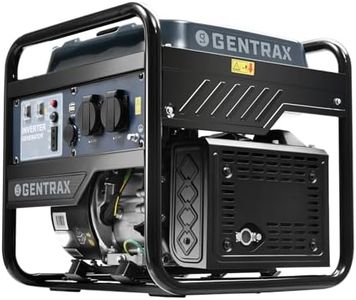
Buying Guide for the Best Generators For Home Use
Choosing a generator for home use is all about balancing your power needs, ease of use, and the specific requirements of your household. Start by identifying the key appliances and systems you want to keep running during an outage—such as refrigerators, heating/cooling, lights, and medical equipment. Understanding both your total and critical power needs will help you narrow down your options and avoid choosing a generator that is either too weak or more complex than you require. Consider also how often you expect to use the generator, whether portability is a priority, and if features like quiet operation or easy start are important for your peace of mind.Wattage (Power Output)Wattage, usually given in starting watts and running watts, tells you how much power the generator can deliver. This is critical because you need a generator that can handle the combined electricity demands of everything you plan to run. Smaller generators (up to 2,000 watts) are good for just the basics like a fridge and a few lights. Mid-range (2,000–5,000 watts) can handle more appliances and even a small furnace or window AC. Larger generators (5,000 watts and up) can power almost all home essentials, possibly even central air conditioning. To choose the right size, make a list of what you need powered, check each item's wattage (often listed on the appliance or in its manual), add them up, and add some extra for safety. Picking the right output ensures you won't overload the generator or have it run inefficiently.
Fuel TypeGenerators run on different fuels such as gasoline, propane, diesel, or even natural gas. This matters because it affects fuel availability, storage, cost, and generator maintenance. Gasoline generators are common and easy to refuel, but gas can be hard to store long-term. Propane burns cleaner and stores longer but may have less energy per gallon. Diesel generators are usually more efficient and durable, but diesel is heavier and less commonly kept around the house. Dual-fuel models can run on more than one type, giving you flexibility. Your choice should hinge on which fuel you can safely store, access during outages, and which is easiest for you to handle.
PortabilityPortability is about how easy it is to move the generator around. Smaller, lighter generators often have handles and wheels and are easy for one person to move. Larger home standby models are meant to be installed in place and stay there. Think about whether you need to move your generator outdoors when you use it, or if you want one that's fixed and turns on automatically. If you only plan to use it in one spot during emergencies, portability may not matter much. But for those who might take it camping or move it around the property, portability becomes more important.
Noise LevelGenerators can be noisy, and their volume is measured in decibels (dB). This is especially important in neighborhoods with noise restrictions or if you’ll be running your generator for long stretches. Quiet models usually operate around 50–65 dB, roughly the noise level of a conversation or dishwasher. Louder models can easily top 70 dB, which is noticeable and potentially disruptive. If you'll use your generator near living spaces or want to avoid bothering neighbors, look for a quiet or 'inverter' model designed for lower noise.
Runtime (on One Tank of Fuel)Runtime tells you how long the generator will run before needing a refill, usually listed as hours at a certain load (like 50%). Longer runtime means you can go overnight or all day before adding more fuel, which is convenient during long outages. Some small generators only run a few hours, while larger tanks may provide 10 hours or more. Pick according to your comfort level and how often you want to refuel. For overnight or extended power, aim for a longer runtime.
Start MechanismGenerators can be started manually (with a pull cord), with an electric push button, or automatically (for standby models wired into your home). Manual start is reliable but requires some effort. Electric start is easier, just press a button (battery may need to be kept charged). Automatic start means the generator powers up by itself when your main power goes out. Choose based on what will be most user-friendly for everyone in your home; for convenience, electric or automatic is best, but for simplicity and reliability, manual works well.
Outlets and ConnectionsGenerators offer various outlets for plugging in appliances—standard household outlets, larger 240V outlets for big appliances, and sometimes USB ports. Some also have ready-to-connect features for transferring power directly to your home's circuits (via a transfer switch). The type and number of outlets affect what and how many devices you can power simultaneously. Think about what you need most: running extension cords to basics, or powering large appliances or whole-house circuits. Match the outlet types and quality to your real-life uses.