10 Best Milligram Digital Scales
From leading brands and best sellers available on the web.By clicking on a link to a third party's website, log data is shared with that third party.
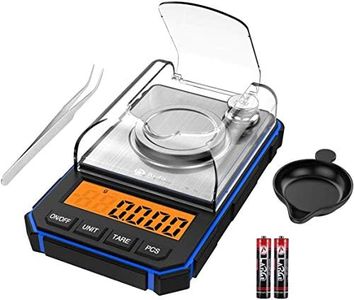
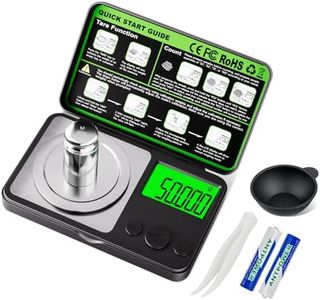
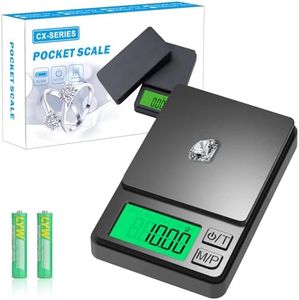

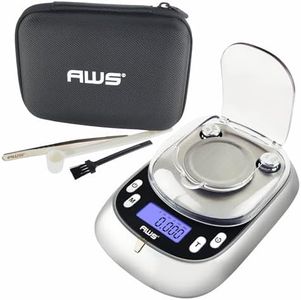
Related Products

Recommended lists

Top rated
Digital Fish Scales
Buying Guide for the Best Milligram Digital Scales
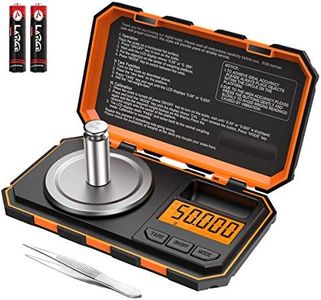
When choosing a milligram digital scale, it's important to focus on your specific needs—what exactly will you be weighing, and how often? Milligram scales are designed for tasks requiring higher precision than standard kitchen or postal scales, so accuracy and consistency matter. Whether you're measuring jewelry, powder, supplements, or chemicals, understanding the main features of these scales can help you make a smart and confident choice. Taking a little time to match the scale's abilities to your tasks will ensure you get results you can trust and a product that serves you well for years.Accuracy/PrecisionAccuracy (sometimes called precision) refers to how close the scale’s measurement is to the true value. For milligram digital scales, this is often shown as 0.001g (1mg), 0.01g (10mg), or 0.1g (100mg). Highly precise models provide readings down to the thousandth of a gram (1mg), while others are less finely tuned. If you need to measure very tiny amounts, like for scientific experiments or fine jewelry, look for a scale with at least 0.001g accuracy. For less critical jobs, like dietary supplements or mixing small amounts, 0.01g or even 0.1g might be enough. Consider your typical measurement needs—opting for higher precision is great, but may cost more and be more sensitive to environmental factors.
CapacityCapacity means the maximum weight the scale can handle. Some milligram scales only go up to 20g, while others might handle 50g, 100g, or even more. The greater the capacity, the more items you can weigh at once, but sometimes maximum capacity and high precision don’t go together. If you mostly weigh small items (like gemstones or powders in small doses), a lower capacity scale with higher precision will suffice. But if you need to weigh objects or batches that are heavier, choose a scale with a capacity that exceeds your typical maximum, while still maintaining the precision you require.
Tare FunctionThe tare function allows you to subtract the weight of a container or tray, so you only measure the item inside. This is crucial for accuracy, especially when working with powders or tiny items that require a dish or bowl. It’s a standard feature on most digital milligram scales, but always double-check that it's present and easy to use. If you often use containers or need to measure multiple items separately, make sure the tare feature is reliable and easily accessible.
Calibration MethodsCalibration is the process of ensuring your scale gives correct readings. Some scales offer automatic calibration, while others are manual and require you to use calibration weights (sometimes included, sometimes not). Frequent calibration is important if you need highly accurate measurements, especially if the scale gets moved often or is used in different environments. If you want an easier user experience, look for automatic calibration. If you are okay with doing some setup and want more control, manual calibration also works—just make sure you have the right weights available.
Display and ControlsA clear display and simple controls make everyday use much easier. Digital milligram scales usually have an LCD display to show your measurements. Consider how visible and bright the readout is, especially if you plan to use the scale in different lighting. Touch buttons may look sleek but might be less tactile, especially with gloves. If you prioritize ease of use, choose a scale with a bright, easy-to-read screen and intuitive buttons. This helps prevent mistakes and improves your overall weighing experience.
Platform Size and MaterialThe platform is where you place your items. Its size and material can affect both usability and durability. A larger platform accommodates bigger items or containers, but if you only weigh very small things, a compact one saves space and may be more stable. Stainless steel platforms are common as they're easy to clean and resist corrosion, but some scales come with plastic or glass options. Choose a platform size and material based on the items you'll weigh and your preferences for maintenance and cleanliness.
Portability and PowerSome milligram scales are designed for portability, running on batteries and being compact enough to carry. Others are larger and run on AC power, better for a fixed location. If you plan to use your scale on the go or in different places, look for compact, battery-powered models. For stationary use, a plug-in option may be more stable and reliable for long sessions.