10 Best Mini Freezers
From leading brands and best sellers available on the web.By clicking on a link to a third party's website, log data is shared with that third party.

Buying Guide for the Best Mini Freezers
When choosing a mini-freezer, the goal is to find an appliance that fits both your space and your storage needs. It's important to think about where you plan to place your mini-freezer, what types of items you'll be storing, and how much flexibility you need for organizing frozen goods. By paying attention to the main specifications, you’ll make sure the freezer is both convenient and efficient for your use.CapacityCapacity refers to how much space is inside the freezer, usually measured in liters or cubic feet. This spec is important because it determines how much food you can store at once. Mini-freezers can be divided into very compact models (under 2 cubic feet), mid-size units (2–4 cubic feet), and larger minis (4–7 cubic feet). If you only need to freeze a few essentials or have very limited space, a smaller capacity may be best. For families, roommates, or meal preppers, a mid- to larger-size mini-freezer helps keep more food frozen without frequent restocking. Think about what and how much you typically freeze to match your habits to the right capacity.
DimensionsThe physical size of the mini-freezer is called its dimensions—height, width, and depth. This matters because you need to make sure the freezer will fit in your intended spot, leaving some space around it for air circulation. Small models might fit under a desk or counter, while bigger ones require more dedicated space. Measure your available area before shopping so you can easily sort through models based on what will actually fit where you want it.
Type (Chest vs. Upright)Mini-freezers generally come as either upright (stand-up with shelves) or chest (horizontal with a top-opening lid). Chest freezers usually offer more usable space and tend to keep cold air inside better, but can be harder to organize and access items at the bottom. Upright freezers provide more organization and are easier to open if you want quick access, but may not use space as efficiently. To decide, consider whether you value easy organization or maximum storage in a small footprint.
Energy EfficiencyEnergy efficiency tells you how much electricity the mini-freezer will use, which affects both the environment and your utility bills. More efficient freezers use less power to keep things frozen. You’ll see energy efficiency labels or estimated annual energy use—for example, in kilowatt-hours per year. For long-term use and lower costs, look for a model with better energy ratings. This is especially important if the freezer will run year-round or in a warm area.
Temperature ControlTemperature control refers to the freezer’s ability to let you adjust and maintain the desired coldness. Some minis have simple dials with basic settings, while others allow more precise adjustments. It matters because different foods may need different temperatures, and being able to set the right level ensures food safety and quality. If you store sensitive items (like ice cream or frozen meals), make sure the freezer has good, reliable temperature control.
Defrost TypeDefrost type describes whether the freezer prevents ice buildup automatically (auto-defrost or frost-free) or if you have to defrost it manually. Auto-defrost saves you the inconvenience of having to unplug and empty the freezer to remove ice, but these models may use more energy and be a little noisier. Manual defrost types are generally quieter and more efficient, but require occasional maintenance. If you prefer low hassle, choose auto-defrost; if you don’t mind some upkeep and want higher efficiency, consider manual.
Noise LevelNoise level tells you how loud the freezer will be while running. Since mini-freezers are often placed in bedrooms, dorms, or offices, quiet operation can be a big plus. Manufacturers sometimes list noise output in decibels (dB). Lower numbers mean quieter performance. If silence is important for your space, pay attention to this spec and, if possible, choose models known for quiet operation.
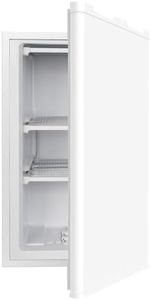
Organization FeaturesOrganization features include shelves, baskets, and dividers inside the freezer that help you separate and store items neatly. If you use your freezer for a variety of foods, look for features that allow you to organize and access things easily. If you mostly use it for bulk storage, simple space may be all you need. Consider your typical frozen goods and how often you want to access or rearrange them.