10 Best NETGEAR Nighthawk Routers
From leading brands and best sellers available on the web.By clicking on a link to a third party's website, log data is shared with that third party.

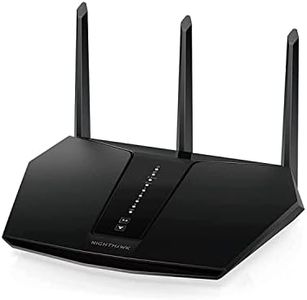
Buying Guide for the Best NETGEAR Nighthawk Routers
Choosing the right router is all about understanding your unique needs for internet usage, coverage area, device connectivity, and specific online activities. Netgear Nighthawk routers are known for their high performance and versatile features, but finding the right one means focusing on the characteristics that matter most for your home or office setup. Start by thinking about the size of your space, the number of people or devices that will be connected, and which activities (like gaming or streaming) are a priority. By matching the router’s capabilities to your lifestyle, you’ll be better equipped to enjoy fast, reliable, and secure internet.Wi-Fi StandardThe Wi-Fi standard (for example, Wi-Fi 5, Wi-Fi 6, and Wi-Fi 6E) refers to the technology used for wireless communication between the router and your devices. Later standards offer improvements in speed, range, device management, and interference resistance. Wi-Fi 5 is suitable for everyday browsing and streaming, Wi-Fi 6 is better for busy households with many devices or smart homes, and Wi-Fi 6E brings an extra frequency band for ultra-fast, low-interference connections ideal for enthusiasts or crowded environments. When choosing, consider how many and what kinds of devices you have and whether you want future-proofing for new tech.
Coverage RangeCoverage range describes how far the router’s Wi-Fi signal can reach, both horizontally and vertically. Larger or multi-story homes will need a router with greater coverage or mesh capabilities, while apartments or small spaces can use basic models. Router specs often list the number of square feet they can cover, but obstacles like walls and floors can affect performance. For large homes or offices, look for models promising extended range or support for additional satellites.
Number and Type of PortsPorts include Ethernet (wired internet), USB (device connectivity), and sometimes other special connections. The number and type of ports determine how many wired devices (like PCs and game consoles) you can plug in directly for maximum speed and reliability. If you plan to use your router as the central hub for a lot of wired gadgets, printers, or external storage, consider a model with more ports. For most people, a few Ethernet ports are enough, but heavy users might need more.
Speed RatingSpeed ratings, given in Mbps or Gbps (for example, 'up to 3600 Mbps'), indicate the theoretical maximum combined data rate the router can handle across all bands. This doesn’t mean every device gets that speed, but it gives a good idea of how well the router can support multiple demanding activities (like 4K streaming, large downloads, or gaming) at once. Lighter users can get by with lower-speed models, but if you have many people streaming or working from home, higher speeds provide extra breathing room.
Number of BandsBands refer to the separate wireless frequency ranges the router can use, like dual-band (2.4 GHz and 5 GHz) or tri-band (with an additional 5 GHz or 6 GHz band). More bands help distribute traffic and reduce congestion, ensuring each device gets optimal performance. Dual-band is suitable for most households, while tri-band is great for heavy users or homes with many devices—especially if you want fast speeds on all devices at the same time.
Security FeaturesSecurity features like WPA3 encryption, automatic updates, guest networks, and built-in firewalls help protect your network from hackers or prying eyes. For basic home use, standard security settings are usually sufficient, but if you have sensitive data, frequent guests, or smart home devices, stronger security features add peace of mind. It’s important to pick a router with updated and easy-to-manage security settings to keep your connection safe.
Parental Controls and QoSParental controls let you manage what content and devices can access the internet, while Quality of Service (QoS) allows you to prioritize certain activities (like gaming or video calls) for smoother performance. These features are very useful for families, shared living spaces, or anyone who wants to fine-tune their online experience. If you need to limit screen time, keep your kids safe, or ensure you always have the fastest connection for work, look for models with simple, robust controls.