9 Best Oscilloscope Multimeters
From leading brands and best sellers available on the web.By clicking on a link to a third party's website, log data is shared with that third party.
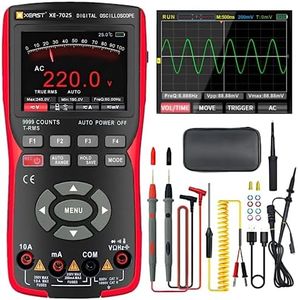
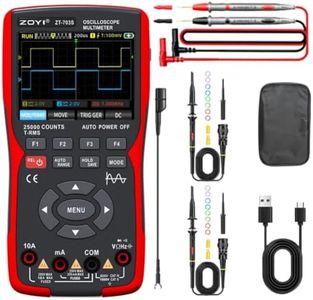
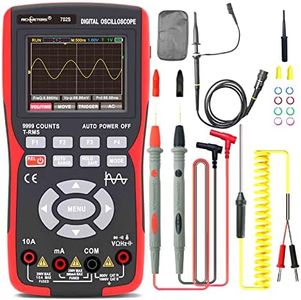

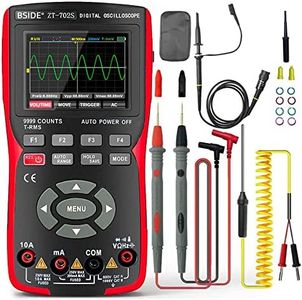
Buying Guide for the Best Oscilloscope Multimeters
Choosing an oscilloscope-multimeter, also known as a scopemeter or hybrid tester, is all about understanding both your need to measure electrical quantities (like voltage, current, resistance) and your need to visualize signal waveforms. The best device for you depends on what kind of electronics you work on, how precise you need your readings to be, and whether portability or advanced features matter for your tasks. Think about the type of signals you'll be measuring and the environments you'll work in, such as a lab, workshop, or field site.BandwidthBandwidth defines how fast a signal can change and still be measured accurately by the oscilloscope function. This spec is critical for catching quick or complex signal details such as spikes or glitches. Bandwidth is measured in hertz (Hz), kilohertz (kHz), or megahertz (MHz). Low bandwidth (up to a few MHz) works for slow signals or basic electronics, while higher bandwidth (tens or hundreds of MHz) is best for fast digital systems and more advanced troubleshooting. Decide what signals and devices you’ll examine—pick higher bandwidth for digital or RF work, and lower for basic AC, DC, or audio signals.
Input ChannelsInput channels refer to how many different signals you can look at simultaneously. Each channel lets you connect a separate probe or lead. One channel is enough for simple checks, but two channels are handy for comparing signals (like input and output of a circuit), and more channels allow for complex diagnostics. Think about whether you usually need to compare two or more signals at once, as more channels add options but can make the device larger or pricier.
Sampling RateSampling rate tells you how many times per second the oscilloscope takes a measurement of the signal. A higher sampling rate means more detailed waveforms and accurate capture of fast events. This measurement is often given as samples per second (Sa/s), with higher values needed for high-frequency or fast-changing signals. For routine analog work, a modest rate is fine, but for digital signals or intricate troubleshooting, choose a higher sampling rate.
Display Type and SizeThe display shows your readings and waveforms. A larger, clearer screen makes it easier to see small details, compare signals, and navigate menus. Some displays are color, some are monochrome, and some touchscreens add convenience. If you’ll use the tool for extended analysis or teaching, a larger color display helps; for quick field checks or tight spaces, smaller ones may suffice.
Multimeter FunctionsOscilloscope-multimeters combine classic multimeter features like voltage, current, resistance, frequency, diode check, and sometimes temperature. Make sure the multimeter side covers the measurements you use most. If you work mainly with AC power, check for True RMS measurement for more accurate readings. If you frequently test batteries, look for good low voltage/current resolution.
Portability and Power SourceSome devices are bench-top units needing constant AC power, while others are handheld or battery-powered for field use. If you’ll be troubleshooting in multiple locations or away from a bench, a portable, rugged design with battery power is helpful. Fixed-location analysis favors larger, AC-powered models. Consider how and where you’ll use it most.
Safety RatingsSafety ratings (often labeled by CAT levels and voltage ratings) indicate the environments and voltages the device can safely handle. Higher CAT numbers mean the meter can be safely used on higher-energy circuits, like industrial or building wiring. If you stick to small electronics, lower ratings are fine, but for mains power or industrial environments, ensure a higher safety rating for protection.
Data Storage and ConnectivityMany modern devices can save measurements or waveforms, and connect to computers or other devices via USB, Bluetooth, or SD card. Data storage and connectivity are useful if you need to analyze results later, generate reports, or share findings. If your workflow involves documenting, teaching, or remote diagnostics, look for robust storage and transfer capabilities.