10 Best Outdoor Laser Levels
From leading brands and best sellers available on the web.By clicking on a link to a third party's website, log data is shared with that third party.
Related Products
Up to 20% off
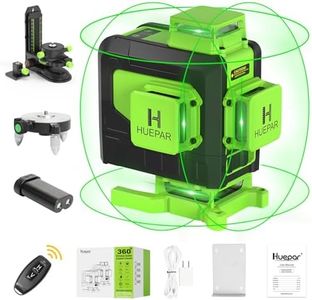
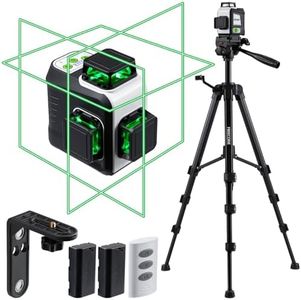
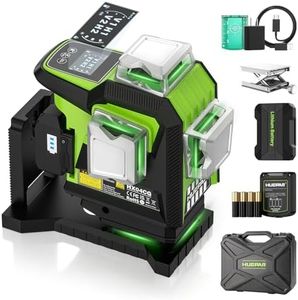
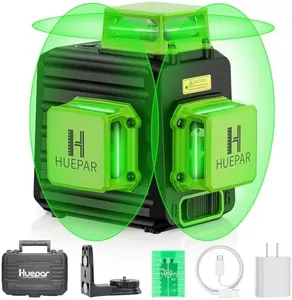
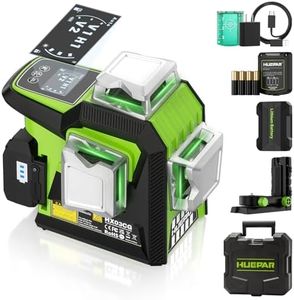
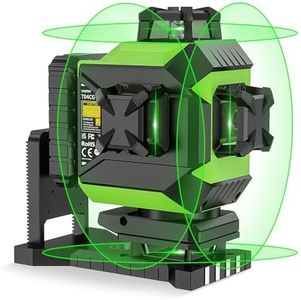
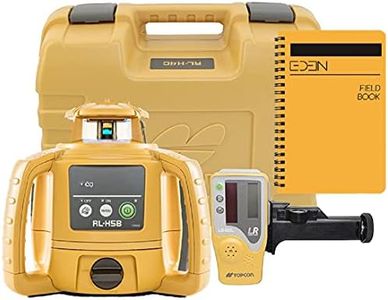
Buying Guide for the Best Outdoor Laser Levels
Choosing an outdoor laser level can make a big difference in the accuracy and efficiency of your outdoor projects, such as landscaping, building, or installing fences. It's important to focus on the key features that will help you get straight lines and level surfaces, even when you're working in bright sunlight or over long distances. Taking time to understand the main specifications will ensure you pick a laser level that fits your needs and is comfortable to use.Laser RangeLaser range refers to how far the laser line or dot can be projected while still remaining visible or detectable, especially when paired with a detector. This spec is important because outdoor jobs often require working over greater distances than indoor tasks. Generally, basic models will offer a range of up to 15-20 meters, suitable for small gardens or patios. Mid-range devices can reach 30-50 meters and are good for general landscaping or decking projects. High-end models can reach 100 meters or more, ideal for construction sites or surveying. To pick the right range, think about the average size of the outdoor spaces you'll be working in.
Self-Leveling CapabilitySelf-leveling means the tool can automatically adjust itself to ensure the laser line is level, even if the device itself is placed on a slightly uneven surface. This is crucial because manual leveling can be time-consuming and prone to errors, especially outdoors where surfaces may be irregular. Some simpler models offer just a visual indicator for manual adjustment, while most outdoor-focused models have full self-leveling mechanisms. For accuracy and speed, choose a model with self-leveling if you expect to work on uneven terrain or need to complete jobs quickly and reliably.
Laser Color (Red vs. Green)The color of the laser can affect visibility in different lighting. Red lasers are the most common and tend to use less battery power, but can be harder to see in bright sunlight. Green lasers are more visible outdoors, especially in daylight conditions, making them preferable for outdoor use, though they usually cost more and use more power. If you often work under strong sunlight, a green laser may help you see the line or dot more easily.
AccuracyAccuracy tells you how close the laser level can keep its projected line to being perfectly straight or level over a certain distance, usually expressed as a deviation per meter. Values like ±0.2mm/m are quite precise, while ±1mm/m or above are less so. If you're doing projects that require tight tolerances, such as laying foundations or framing, a higher accuracy rating matters more. For less critical work, slightly lower accuracy may still be acceptable.
Power Source and Battery LifeOutdoor laser levels are typically powered by rechargeable lithium-ion batteries or replaceable AA/AAA batteries. Long battery life is important for extended projects outdoors where it may not be easy to recharge. Shorter battery lives may be manageable for quick jobs. If you expect to be on-site for many hours, prefer models with longer battery capacities or options for quick battery swaps.
IP Rating (Ingress Protection)The IP rating shows how well the laser level is protected from dust and water. Ratings like IP54 mean some resistance to dust and water splashes, while higher ratings such as IP65 offer better protection. For outdoor use, where rain and dust are common, it’s safer to choose a higher IP rating to prevent damage and extend the tool's life.
Mounting OptionsLaser levels can often be mounted on tripods, attached to poles, or clipped onto various surfaces. The available mounting options are important because outdoor ground may be uneven, and you might need to set up your level in a variety of positions. Look for compatibility with standard tripods or adjustable mounting brackets for the most flexibility, especially if you work on a range of project types.