10 Best Quiet Airbrush Compressors
From leading brands and best sellers available on the web.By clicking on a link to a third party's website, log data is shared with that third party.


Related Products



Buying Guide for the Best Quiet Airbrush Compressors
Choosing a quiet airbrush compressor can make a big difference in your creative experience, whether you're working on hobbies, crafts, or professional art. The goal is to find a compressor that delivers a steady airflow while keeping noise to a minimum, so you can work comfortably at home, in apartments, or in studios without causing disruptions. To make the best choice, understanding the key specifications and your own needs—like how often you paint, how large your projects are, and your sensitivity to noise—will help you narrow down your options effectively.Noise Level (Measured in Decibels, dB)Noise level indicates how loud the compressor will be while running. This is important if you want a peaceful environment, will work in shared spaces, or want to avoid disturbing others. Generally, compressors under 50 dB are considered ultra-quiet (roughly like a refrigerator running), 50–60 dB are moderate (similar to a conversation at home), and above 60 dB can be noticeably louder. If quiet operation is your top priority, aim for compressors at the lower end of this spectrum. Consider when and where you'll use the compressor, and how much noise you (or others nearby) can tolerate.
Air Delivery (Measured in Liters Per Minute or Cubic Feet Per Minute)Air delivery refers to how much air the compressor provides to your airbrush, which is crucial for smooth and continuous spraying. Higher airflow is necessary for larger projects or when working at higher speeds; smaller or detail-oriented work can get by with lower rates. Standard home-use or hobby compressors typically provide between 10–25 L/min, while professional or multi-airbrush setups may need more. Assess the kind of work you'll do—if you focus on fine details or miniatures, lower airflow is often sufficient, but for bigger surfaces or multitasking, a higher rate is advantageous.
Pressure Range (Measured in PSI—Pounds per Square Inch)Pressure tells you how strong the air stream will be. Most airbrush work is comfortable in the 10–40 PSI range. Lower pressure is ideal for fine details or delicate surfaces, while higher PSI is better for broader coverage or thicker paints. Some compressors allow you to adjust pressure, while others have a fixed output. Think about what types of projects you'll do most—those working mainly with details can go lower, but versatility is helpful if you change styles or media often.
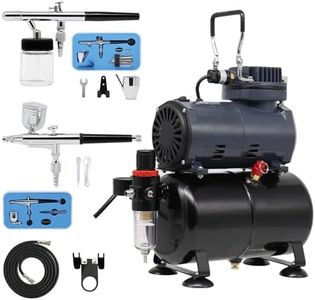
Tank vs. Tankless DesignSome airbrush compressors have a small air tank, while others are tankless. Tank compressors store compressed air, offering smoother airflow and less frequent cycling, which helps reduce both noise and wear. Tankless designs are more compact and portable but may have pulsing air output and can run noisier over time. If you value consistency, plan longer sessions, or want an even spray, a model with a tank (even a small one) is better. If space-saving and portability are key, a tankless option may suffice, especially for short or light-duty use.
Auto-Stop/Start FunctionThis feature automatically turns the compressor off when the desired pressure is reached, and back on when it drops. It's important because it reduces noise, wear on the motor, and energy use. If you want a quieter workspace and a longer-lasting compressor, this function is handy. If you tend to pause between bursts of painting or won't use the compressor continuously, an auto-stop/start model is more convenient and quieter overall.