10 Best Replacement Trampoline Mats
From leading brands and best sellers available on the web.By clicking on a link to a third party's website, log data is shared with that third party.



Related Products
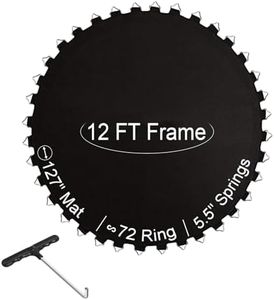


Buying Guide for the Best Replacement Trampoline Mats
Choosing the right replacement trampoline mat is essential for safety, performance, and the longevity of your trampoline. The ideal mat will keep your bouncing experience safe and enjoyable while matching your trampoline's frame and spring design. Before purchasing, you’ll want to take careful measurements of your trampoline, think about who will be using it, and consider your expected usage frequency. Keep in mind that the wrong mat can lead to poor bounce, frame mismatch, or safety hazards, so understanding the key specs is crucial.Mat Size (Diameter or Shape)The size of the mat is the diameter (for round trampolines) or the length and width (for rectangular or oval trampolines) measured from edge to edge of the mat, not including the springs. This specification is vital because the wrong size mat simply won’t fit your trampoline frame—an undersized mat will not reach the springs, and an oversized one will sag and not provide a safe bounce. To pick the right size, carefully measure your trampoline’s frame from edge to edge, across its widest point. Make sure to match the mat shape (round, rectangular, oval, square, etc.) to your frame. If you’re unsure, measure it twice and consult the trampoline’s manual for the correct numbers.
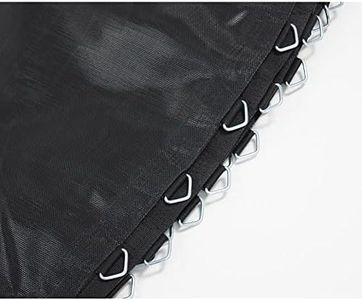
Number and Placement of Spring HolesThis refers to how many attachment points (usually metal rings or v-rings) are around the edge of the mat, which connect to the springs on the trampoline frame. The number and spacing must match your frame exactly—otherwise, the mat won’t fit securely and could be unsafe. To choose correctly, count the number of springs on your old trampoline and ensure that the new mat has the same number of attachment points spaced similarly. Take a section of your current mat and verify the pattern. The right fit guarantees safety and optimal bounce.
Spring Size CompatibilityEvery trampoline uses springs of a particular length, typically measured from hook to hook when fully removed and un-stretched. Mats are designed for specific spring sizes. Using the wrong mat can put too much strain on the springs or the mat, which can reduce bounce quality or cause premature wear. Before buying, measure your current springs and check that the replacement mat is rated for use with that spring length. If you want a firmer bounce for smaller children, shorter springs with a compatible mat might be preferable. For adults or higher bounce, longer springs with the correct mat offer more flexibility.
Mat Material and UV ResistanceTrampoline mats are generally made from heavy-duty woven polypropylene or similar synthetic materials, and UV resistance is added to prevent breakdown from sunlight. Higher-grade materials are more durable and less likely to tear, fade, or stretch out of shape with regular outdoor exposure. If your trampoline is outside and used heavily, UV resistance is key for a long-lasting mat. For indoor or infrequent use, this may be less crucial. Consider your climate and typical sunlight when prioritizing this feature.
Maximum Weight CapacityThis is the highest total user weight the mat is designed to safely support. It’s important for safety—using a mat beyond its weight rating can cause it to stretch, break, or lose bounce quality. Choose a mat whose capacity matches or exceeds the combined weight of typical users. For families with multiple users or older jumpers, opt for a higher maximum weight capacity for peace of mind.
Stitching Quality and ReinforcementThis refers to the way the mat edges are sewn and reinforced, often with multiple rows of stitching or an extra-strong border. Better stitching quality helps prevent the mat from tearing around the spring attachment points, especially with frequent use and exposure to the elements. If your trampoline gets heavy or frequent use, look for mats that advertise extra reinforcement or multiple rows of stitching. Lighter use may allow for less reinforcement, but stronger stitching always contributes to safety and lifespan.