10 Best Rv Speakers
From leading brands and best sellers available on the web.By clicking on a link to a third party's website, log data is shared with that third party.
Related Products
Up to 6% off

Buying Guide for the Best Rv Speakers
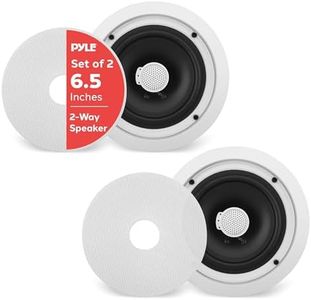
Choosing the right RV speakers can make your travel experience much more enjoyable, adding rich sound to your road trips or camping adventures. Because the space inside an RV is limited and subject to more noise and vibrations, you need to consider features that are uniquely important compared to home or car audio systems. Start by determining where you want to install the speakers – inside, outside, or both – and think about the type of sound experience you’re looking for: immersive music, clear podcasts, or even surround sound for movies. With a clear understanding of your needs and some basic knowledge of the key specifications, you'll be well-equipped to select the ideal speakers for your RV.Speaker SizeSpeaker size refers to the physical diameter of the speaker cone, typically measured in inches. This spec matters because it influences both the ease of installation and the quality of sound, especially bass response. Small speakers (4-5 inches) are easy to fit into tight spaces and are great for background audio but may lack deep bass. Medium sizes (6-6.5 inches) offer a balanced sound and fit most RV spaces while still being easy to install. Larger speakers provide stronger bass and louder audio but may require more space or modification. Assess your available mounting space and how much you value deep, full sound to choose the right size.
Power Handling (Wattage)Power handling, or wattage, is the maximum amount of power a speaker can handle without being damaged. It's usually given as RMS (continuous power) and peak (short bursts). For RVs, RMS wattage gives a better idea of what a speaker can comfortably keep up with, which impacts overall volume and clarity. Lower wattages (20-40W RMS) are fine for background or gentle use, mid-range (40-80W RMS) works well for more vibrant music or movies, and higher wattages are suited for those wanting a big sound experience. Match your needs (like casual listening vs. party-level sound) and your RV’s audio system output when picking power handling.
Weather ResistanceWeather resistance tells you how well speakers can handle humidity, rain, sun, and temperature changes – all important for RVs, especially for outdoor installations. Some speakers are labeled as water-resistant or waterproof and UV-resistant. Choose standard indoor speakers for protected, inside locations, but for outdoor use or in humid locations (like bathrooms), prioritize models with clear weather-resistant ratings to ensure long-lasting performance.
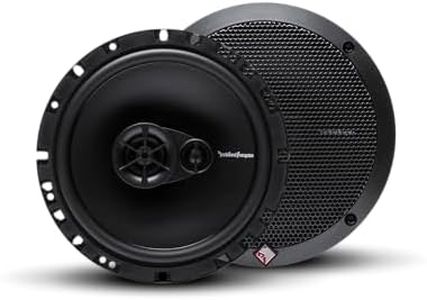
Speaker Type (Coaxial vs. Component)RV speakers typically come as either coaxial (full-range) or component systems. Coaxial speakers combine multiple speakers (like woofer and tweeter) in a single unit and are straightforward to install, making them great for quick upgrades and casual listeners. Component speakers separate these elements for potentially higher sound quality but are trickier to install and better suited for audiophiles or those looking to build a high-end system. Think about how much effort you want to put in and what sound quality matters most to you when making your choice.
ImpedanceImpedance, measured in ohms, shows how much resistance the speaker has to the audio signal. Common values are 4 or 8 ohms. Most RV systems are designed around 4-ohm speakers, as they draw more power and tend to play louder. Higher impedance (like 8 ohms) is more common in home audio systems. Check your RV’s stereo or amp to match the impedance for best performance and avoid damaging your system.
Mounting Depth and ShapeThis is the amount of space a speaker requires behind the mounting surface. RV walls and ceilings can be thin with limited cavity space, so knowing the mounting depth ensures a proper fit without damaging the speaker or your RV. Shallow-mount speakers are ideal if space is tight, while standard mounts can be used if there is ample room. Always measure your intended installation location before buying to avoid installation issues.