10 Best Rv Water Pumps
From leading brands and best sellers available on the web.By clicking on a link to a third party's website, log data is shared with that third party.
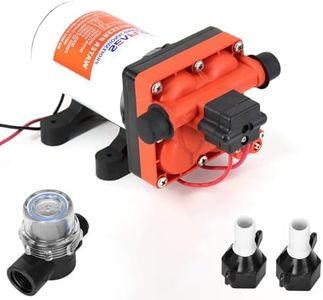
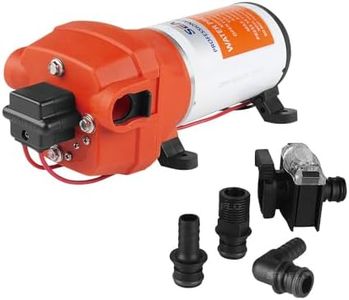
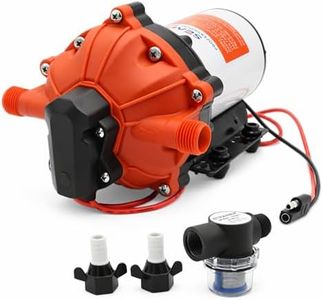
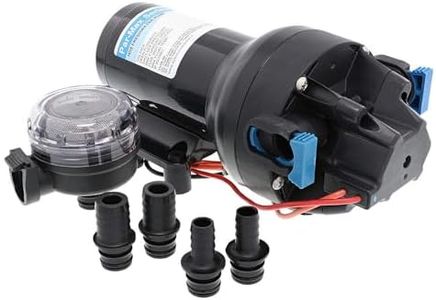
Related Products


Buying Guide for the Best Rv Water Pumps
Choosing the right RV water pump ensures you have reliable water flow for all your daily needs, such as showering, washing dishes, and flushing the toilet while on the road. When selecting a model, you want a pump that matches your RV’s water system and supports your typical usage level without being too loud or draining your power supply unnecessarily. Understanding the key features and how these relate to your daily habits will help you make a choice you’re happy with in the long run.Flow Rate (GPM)Flow rate, typically measured in gallons per minute (GPM), tells you how much water the pump can deliver at any given moment. This is important because a higher flow rate means more water is available for tasks like showers or filling a sink quickly. Pumps generally fall into three ranges: low flow (under 3 GPM), mid-range (3-5 GPM), and high flow (over 5 GPM). If you mostly travel alone or with a partner and use water sparingly, a lower GPM is usually sufficient. For families or those who expect to use multiple water sources at once, a higher GPM is better to avoid weak water streams.
Pressure (PSI)Pressure, measured in pounds per square inch (PSI), refers to the force at which water comes out of your taps. Adequate pressure ensures water flows smoothly but too much can strain your plumbing. RV water pumps typically range from 40 PSI to 70 PSI. Lower PSI (40-50) is adequate for basic needs, while higher PSI (55-70) ensures a stronger flow, which is useful for multiple simultaneous uses. If your RV has delicate plumbing or older fixtures, leaning towards moderate PSI is best. Those wanting a more ‘home-like’ experience often prefer pumps with higher PSI.
Noise LevelNoise level describes how loud the pump is when running. Since RVs are small spaces, a quieter pump can make a big difference to comfort, especially at night. Pumps are described as standard or ‘quiet’ operation, and often mention decibel ratings. If you value peace and quiet, seek out units specifically designed to run quietly or those with noise-dampening features. Lighter sleepers or people who often use water overnight will particularly benefit from a low-noise model.
Amperage DrawAmperage draw indicates how much electrical power the pump uses when operating. It’s measured in amps, and RV pumps range from about 3 to 10 amps. Lower amp pumps are ideal if you want to conserve battery power or often camp without hookups, while higher amp pumps may move more water but can deplete batteries faster. If you rely on solar panels or have limited battery capacity, choose a low-amp model.
Self-Priming CapabilitySelf-priming capability means the pump can draw water up from the tank even if the lines have air in them, crucial when your tank sits below the pump or after storage periods. Some pumps are only effective with short distances, while others can suck water up vertically several feet. If your water tank is far below your pump or you store your RV for a while, you’ll need a stronger self-priming pump to ensure consistent flow.
Size and Mounting StyleSize and mounting style refer to the physical dimensions of the pump and how it fits in your RV’s water bay. Space is often limited, so check the available area and choose a pump that fits comfortably without blocking access to other components. If you have limited room or complex plumbing, look for compact, flexible-mounting pumps. This ensures easy installation and future maintenance.