10 Best Sliding Mitre Saws
From leading brands and best sellers available on the web.By clicking on a link to a third party's website, log data is shared with that third party.

Related Products

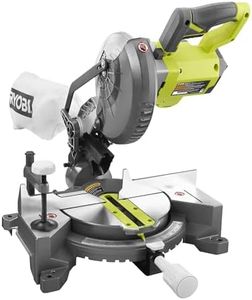
Buying Guide for the Best Sliding Mitre Saws
Choosing a sliding mitre saw can make a real difference if you’re working with wood, trimming mouldings, or tackling DIY projects that require accurate angled cuts. Sliding mitre saws are popular because they allow the blade to move forward and backward, meaning you can cut wider pieces of material than with a basic mitre saw. As you shop, it’s important to match the tool’s features to the kind of work you’ll be doing, ensuring your saw is both safe and effective for your projects.Blade SizeBlade size is one of the most important features in a sliding mitre saw. It refers to the diameter of the saw blade, commonly ranging from 7-1/4 inches to 12 inches. The size determines how deep and wide you can cut in one pass. Smaller blades tend to offer more control and are suitable for detailed work or thinner materials, while larger blades allow you to cut through thicker or wider boards. Think about the materials you commonly work with—if you're dealing with baseboards, framing lumber, or bigger pieces, a larger blade size is beneficial. For trim work, crafts, or small repairs, a smaller blade might be enough.
Sliding FeatureThe sliding feature means the saw head can move forward and backward, significantly increasing the width of material it can cut. All sliding mitre saws have this, but the smoothness and length of the slide can vary. For cutting wider boards or making repetitive long cuts, look for a saw with a high slide capacity. If you mostly make narrower cuts, you might not need the maximum sliding range, and a more compact or lighter model could be easier to handle.
Mitre and Bevel RangeMitre refers to the saw’s ability to pivot left or right for angled cuts, while bevel means the blade can tilt to the side for angled cuts through the thickness of the board. The degree of mitre and bevel adjustment varies between models. If you need to make compound cuts (angled in two directions at once), like for crown moulding, look for a saw with wide mitre and bevel ranges, and preferably dual bevel if you want to tilt left and right without rotating the workpiece. For straightforward projects, a single bevel and basic mitre adjustments may be enough.
Cutting CapacityCutting capacity indicates the maximum size of wood the saw can handle at various angles. This is usually shown as the maximum width and thickness the saw can cut at 90 degrees (straight) and at 45 degrees (angled). If you plan to cut large pieces, check these numbers carefully. For regular household trim or picture frames, a moderate capacity suffices. For larger renovation or carpentry tasks, a higher cutting capacity ensures you won’t be limited by your tool.
Laser Guide or LED Shadow LineSome sliding mitre saws include a laser guide or an LED shadow line, designed to help you line up your cuts more precisely. A laser projects a line on the material, while an LED casts a shadow from the blade itself. These features are helpful if you want extra accuracy or if you’re new to using power tools, but are not strictly necessary for everyone. Consider this if you want help making straight, clean cuts on your first try.
Dust CollectionCutting wood creates a lot of sawdust, and a good dust collection system helps keep your work area cleaner and makes it easier to see your cut lines. Saws may come with a simple dust bag or a port for attaching a vacuum. If you’re working in a workshop or shared space, or if you have allergies, pay attention to the quality and compatibility of the saw’s dust collection. Basic bags catch only some dust, so for cleaner environments, look for a model that works with standard shop vacuums.
Safety FeaturesSafety features often include blade guards, electric brakes that quickly stop the blade after a cut, and easy-to-use switches. These features are important for everyone but especially for less experienced users. Electric brakes and clear blade guards add an extra layer of protection. If safety is a top priority for you or if you’re new to power tools, choose a saw that has these safeguards clearly outlined.