10 Best Thin Portable Charger
From leading brands and best sellers available on the web.By clicking on a link to a third party's website, log data is shared with that third party.
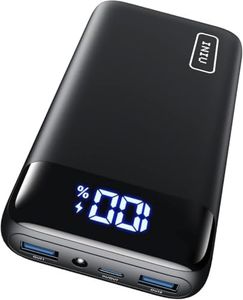
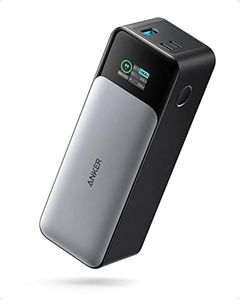

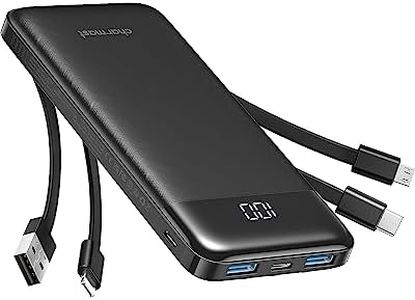
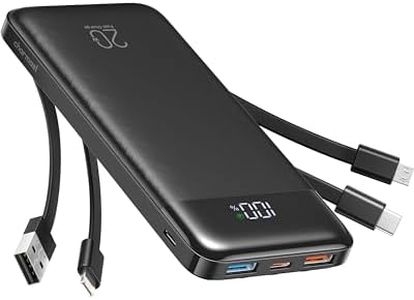
Related Products
Up to 45% off
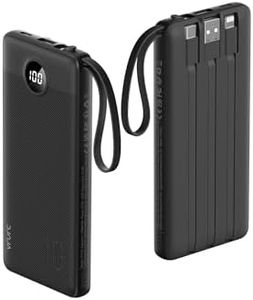
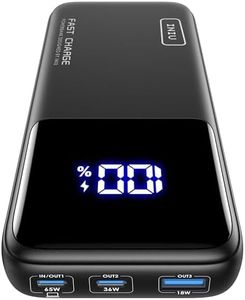

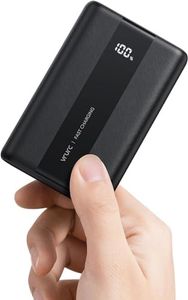
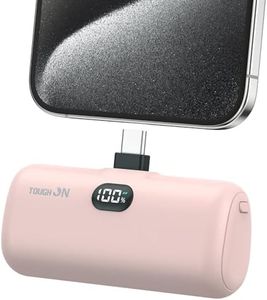
Recommended lists

Top rated
Portable Chargers
Buying Guide for the Best Thin Portable Charger
When shopping for a thin portable charger, it's important to focus on how you'll use it. Consider situations where size and weight matter, such as traveling, commuting, or daily carrying in a small bag or pocket. You should balance portability with performance so it meets your charging needs without being a burden to carry. Before buying, think about what devices you need to charge, how often, and under what circumstances.Capacity (mAh)Capacity, measured in milliampere-hours (mAh), tells you how much charge the power bank can store. It's an important factor because it determines how many times you can recharge your device before the power bank itself needs to be recharged. Lower capacity chargers (around 2,000–5,000 mAh) are very compact and lightweight but typically only provide one full smartphone charge. Mid-range capacities (5,000–10,000 mAh) can charge most phones 1–2 times and are still fairly slim. Higher capacities (10,000 mAh and above) give you several charges but tend to be bulkier, which may reduce portability. Choose the capacity according to how long you'll be without access to a power outlet and the size of the devices you plan to recharge.
Thickness and WeightThe whole point of a thin portable charger is ease of carry, so thickness and weight are crucial. Thinner models fit better into pockets and slim bags, usually ranging from about 0.3 to 0.6 inches thick. Lighter models weigh under 200 grams, making them easy to carry all day. However, thinner and lighter power banks may have slightly lower capacity. Think about whether you want the absolute slimmest option you can get, or if you can tolerate a little more bulk in exchange for extra battery life.
Output Ports and Charging SpeedThe number and type of output ports determine what devices can be charged and how quickly. Basic power banks might have a single USB-A output, while others include USB-C or even Lightning ports for Apple devices. Charging speed is measured in watts (W) or amps—standard chargers deliver about 5W (1A at 5V), while 'fast charging' ones can deliver 10W, 18W, or more. If you only need to charge one device at a time, a single port may suffice. If you have multiple gadgets, look for two or more ports. Consider faster output for devices like tablets or if you want to charge quickly in short breaks.
Input Type and Recharging TimeThe input port is what you use to recharge the power bank itself. Common types are micro USB, USB-C, or Lightning. USB-C is becoming the standard due to its faster charging and universal compatibility. Recharging time depends on both the input type and the input rate (measured in amps). A faster recharging time means less downtime when your power bank runs low. If you'll need to recharge often or want the same cable for most of your devices, lean toward models with USB-C input.
Build Quality and Safety FeaturesBuild quality affects how durable and reliable your power bank will be, especially if you carry it everywhere. Look for models with robust casing, preferably with impact resistance. Safety features like overcharge, short-circuit, and temperature protection are important for keeping your devices safe. If you travel a lot or use the charger in tough environments, prioritize models with good build and certified safety components.