10 Best Truck Bed Ramp
From leading brands and best sellers available on the web.By clicking on a link to a third party's website, log data is shared with that third party.
Recommended lists

Top rated
Truck Bed Tents
Buying Guide for the Best Truck Bed Ramp
Choosing the right truck-bed ramp is essential for safely and efficiently loading and unloading items like lawnmowers, ATVs, motorcycles, or heavy equipment into your truck bed. Understanding the features that matter most can help you avoid frustration, damage, or injury, and ensures that the ramp you buy truly fits your needs and vehicle. By considering a few key specifications, you can be confident in selecting the best ramp for your specific situation.Weight CapacityWeight capacity tells you how much weight the ramp can safely support at one time, often listed per pair or per single ramp. This is crucial because exceeding the ramp’s rated capacity can be dangerous, causing the ramp to bend, break, or become unstable. Weight capacities usually range from around 500 pounds up to several thousand. Light-duty ramps (under 1000 lbs) are for items like lawnmowers or small garden equipment. Medium-duty ramps (1000–2000 lbs) are good for ATVs or heavy snowblowers. Heavy-duty ramps (over 2000 lbs) can handle larger motorcycles or heavy machinery. To pick the right weight capacity, consider the heaviest item you plan to load and make sure the ramp’s rating exceeds this by a comfortable margin for extra safety.
Ramp LengthRamp length measures how long the ramp is from one end to the other when fully extended. This matters because a longer ramp reduces the angle between the ground and your truck bed, making it safer and easier to push or ride items up without tipping, slipping, or bottoming out. Short ramps (4–6 feet) are portable but create a steep incline, suitable only for low truck beds and lighter loads. Medium ramps (7–9 feet) offer a gentler angle, fitting most standard trucks and uses. Long ramps (10+ feet) are best for high truck beds, especially if loading heavy or low-ground-clearance equipment. To decide what length you need, check your truck’s bed height and the kind of gear you’ll be loading; taller beds or low-clearance vehicles need a longer ramp.
Ramp WidthRamp width refers to how wide each ramp or the overall ramp surface is. This feature is important to ensure that whatever you’re loading fits comfortably without wheels or feet slipping off the side. Single-wide ramps are typically used for motorcycles or items with a central wheelbase, while twin-runner ramps (two separate ramps) are best for four-wheeled vehicles like ATVs or lawnmowers, and allow adjustable spacing. Narrow ramps (8–12 inches each) are suited for smaller wheels or lighter equipment. Wide ramps (over 18 inches each or 40-inch full-width) are easier to use with broader vehicles and give a feeling of stability. Choose a width that gives enough room for your equipment to roll safely with some margin for steering or wobbling.
MaterialThe most common materials are aluminum and steel, each affecting the ramp’s weight, durability, and ease of handling. Aluminum ramps are lightweight and rust-resistant, making them easy to move and store, but may be less sturdy for very heavy loads if not well-made. Steel ramps are heavier and typically stronger, offering higher weight capacities, but can rust over time and are harder to carry. There are also composite/plastic ramps for very light-duty needs. When choosing material, think about how much you need to move the ramp, the environment you’ll store it in (wetter climates may prefer rust-proof aluminum), and the weight of what you plan to load.
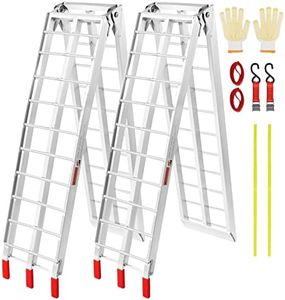
Folding & StorageFolding and storage options describe whether your ramp collapses, folds in the middle, or separates into sections, making it easier to transport and store. Non-folding ramps are rigid and sturdy but take up more space, while folding ramps can often fit behind a seat or under the truck bed when not in use. Some ramps fold once (bi-fold) or twice (tri-fold), and a few roll up. If you want a ramp that you can easily carry along, choose one that folds compactly yet locks solidly into place when open. For infrequent use or if storage space isn’t an issue, a fixed (non-folding) ramp may be preferable for its simplicity.
Traction SurfaceThe traction surface refers to the texture or grip features built into the ramp’s surface to help prevent wheels or feet from slipping, especially in wet or muddy conditions. Some ramps use raised ridges, punch-plate designs, rubber coatings, or textured metal. More aggressive traction is better for outdoor, muddy, or variable conditions, or if you’ll be loading powered vehicles. For lighter items or dry climates, a simpler surface may be enough. Pick a traction surface based on the types of wheels (knobby tires vs. slick) and your typical weather conditions to ensure safety during loading.
Attachment & Safety FeaturesAttachment and safety features are the ways a ramp secures to your truck bed, and any extra elements designed to keep the ramp in place while in use. Many ramps include safety straps, hooks, or rubber-coated ends to help prevent slipping off the tailgate. Having reliable attachments is critical to prevent accidents—always look for ramps with built-in safety means, and use them every time. Choose one with robust securing options if you’ll be working on sloped or uneven ground, or loading alone.